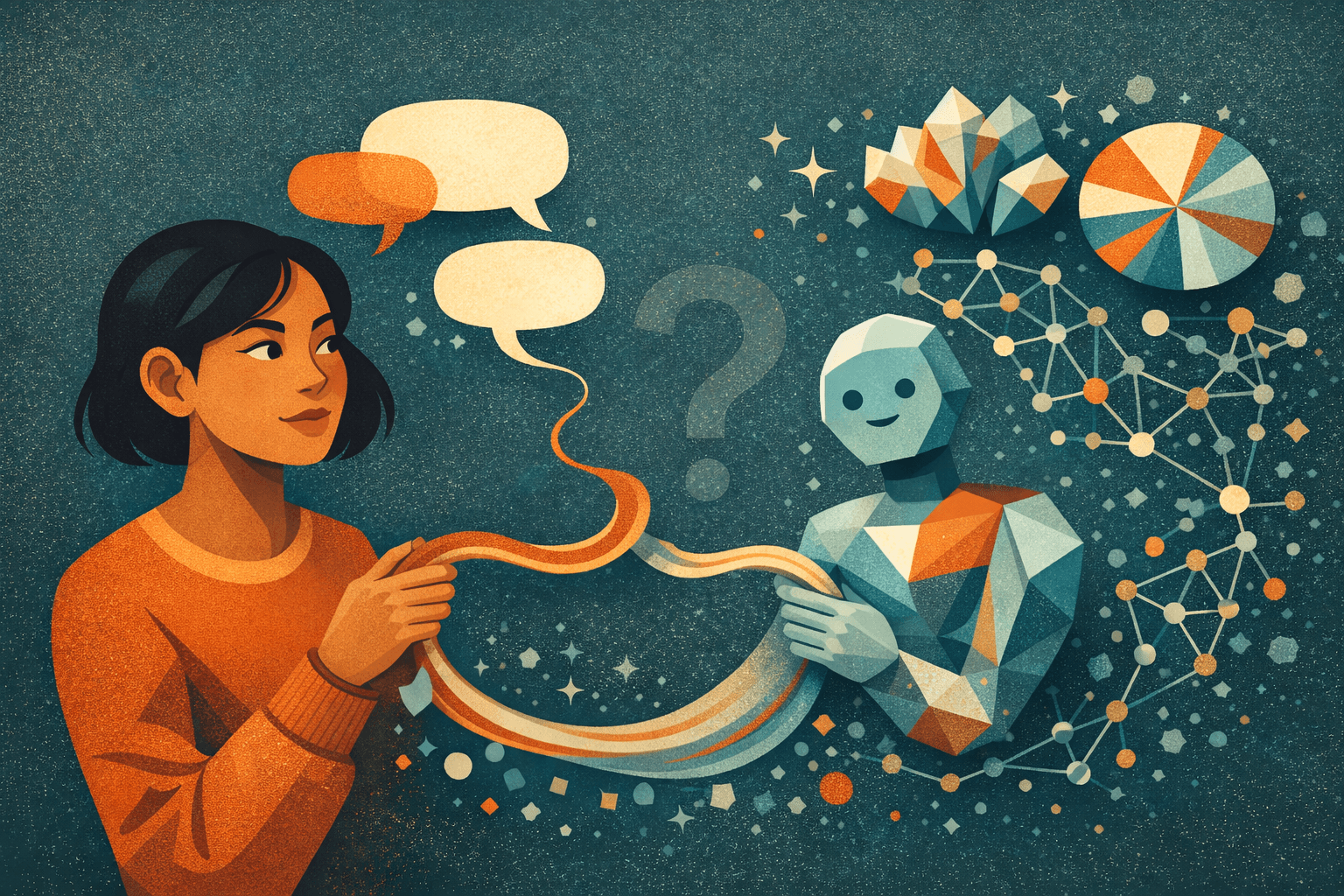
In short: UX research is fundamentally changing right now. The work is shifting away from data collection toward strategic consulting. New skills like prompt engineering and agentic coding are becoming essential. But empathy and judgment remain irreplaceable. Those who don't learn to work with AI now will fall behind.
Look at job postings for UX researchers. On Indeed, LinkedIn, everywhere. The core responsibilities haven't really changed: conducting user interviews, planning usability tests, developing personas, creating journey maps, presenting findings. That's what the profiles said in 2025, same as 2019.
What's changing isn't the official job description. It's how the work gets done.
According to Nielsen Norman Group, 92% of UX professionals already use generative AI tools. And not just occasionally. UX sits in the 94th percentile of all professions when it comes to AI usage. This means: the transformation isn't happening someday. It's happening now, as you read this.
The Big Shift
You used to conduct interviews, transcribe them, organize the statements thematically, find patterns, and write reports. Much of it was manual work. Time-consuming, but manageable.
Today it looks different. AI handles the repetitive tasks. Transcription? An AI does it in minutes with less than 4% error rate. Initial thematic analysis? LLMs achieve 81% agreement with human analysts. That's almost as good as agreement between two humans.
So what's left for the researcher?
In my view, it's strategy, judgment, context: the ability to turn data into real insights and translate those into decisions.
The State of User Research Report 2025 by User Interviews shows the problem: for every researcher, there are five people who want research done. That ratio was 2:1 in 2020. Teams are overwhelmed. They can't even handle half the requests. So they have to prioritize. And that's exactly where strategic thinking becomes more important than execution.
The New Skills
What do you need to master to stay relevant in this new world? According to Salesforce, the half-life of AI skills is now just a few months. What's state-of-the-art today might be outdated in six months. That makes continuous learning mandatory.
What Remains Irreplaceable
With all this change, there are things AI cannot do. And these aren't minor things.
Empathy. Genuine understanding of what people feel and why. AI can analyze sentiment, but it doesn't understand what it means when someone hesitates while telling their story. It doesn't see body language. It has no sense for the space between words.
Judgment. The ability to decide what matters and what doesn't. AI finds patterns. But which pattern is relevant for this specific product, this audience, this context – that's your call.
Stakeholder connection. Convincing people. Building trust. Presenting insights in ways that create impact. That's relationship work. And AI doesn't build relationships.
The researchers who will succeed are those who adapt to new tools while preserving the core abilities that make research valuable.
Practical Steps
What can you do concretely? Here's a plan for the next twelve months.
This week: Try an AI transcription tool. Deepgram, Whisper, whatever. Have your next interview transcribed and compare it to what you hear. Understand where the limits are.
This quarter: Experiment with an LLM for analysis. Take an old interview transcript and have Claude or ChatGPT identify the main themes. Compare with your own analysis. What does the AI find that you missed? What does it miss?
This year: Learn the basics of agentic coding. You don't need to know Python. But you should understand how to build simple automations using natural language. An afternoon with Cursor or a similar tool is enough to start.
The IDC report shows: only a third of employees received any AI training last year. At the same time, AI skills are the fastest-growing skill gap. Those who learn now have an advantage.
The Real Question
In the end, this isn't about whether AI will replace UX researchers. It won't. But AI is changing what the job means.
You'll spend less time collecting data and more interpreting it. Less executing and more strategizing. Less working alone and more enabling others. That's not a loss. It's an opportunity.
The best researchers will be those who use AI as an amplifier. Who get to insights faster while maintaining depth. Who enable more studies while ensuring quality.
That requires new skills. It requires continuous learning in a field that changes every few months. It requires willingness to let go of familiar ways of working.
But those who manage it will be more relevant than ever. Because in a world full of AI-generated data, the ability to turn that data into real understanding becomes more valuable, not less.
Frequently Asked Questions
What new skills do UX researchers need in 2026?
The five most important new skills are: prompt engineering and AI literacy, agentic coding, bias mitigation, research operations, and strategic consulting. Of these, strategic consulting is the most important – the ability to translate insights into business decisions.
Will AI replace UX researchers?
No. While AI is changing what the job means, it won't replace the role. Work is shifting from data collection to interpretation, from execution to strategy. Empathy, judgment, and stakeholder relationships remain irreplaceable.
How many UX professionals already use AI tools?
According to Nielsen Norman Group, 92% of UX professionals already use generative AI tools. UX sits in the 94th percentile of all professions when it comes to AI usage.
What is agentic coding for UX researchers?
Agentic coding means using tools like Cursor or Claude to describe what you need in natural language – the AI then writes the code. For researchers, this enables things like automatic transcript analysis or support ticket clustering without programming knowledge.
What can AI tools still not do in UX research?
AI cannot show genuine empathy, read body language, make contextual judgments, or build stakeholder relationships. It finds patterns, but whether a pattern is relevant is a human decision.
Sources: Nielsen Norman Group (2025), User Interviews State of User Research Report 2025, Lyssna UX Research Trends 2026, Salesforce AI Skills Report, IDC Workforce Readiness Study, Indeed/Toptal UX Researcher Job Descriptions 2025.