A mid-sized company, 800 employees, southern Germany. Eight months ago, the executive team decided to roll out AI across the board. Copilot for everyone. New workflows in marketing, customer service, product development. Budget: six figures. Expectation: a leap in productivity.
Eight months later, the numbers tell a different story: productivity hasn't risen, it's fallen. Two key departments have seen turnover double, and the latest engagement survey sits at 5.9 out of 10 – half a point lower than just three months before. Leadership is wondering whether they picked the wrong tools.
They didn't. The tools work fine. What doesn't work is the culture.
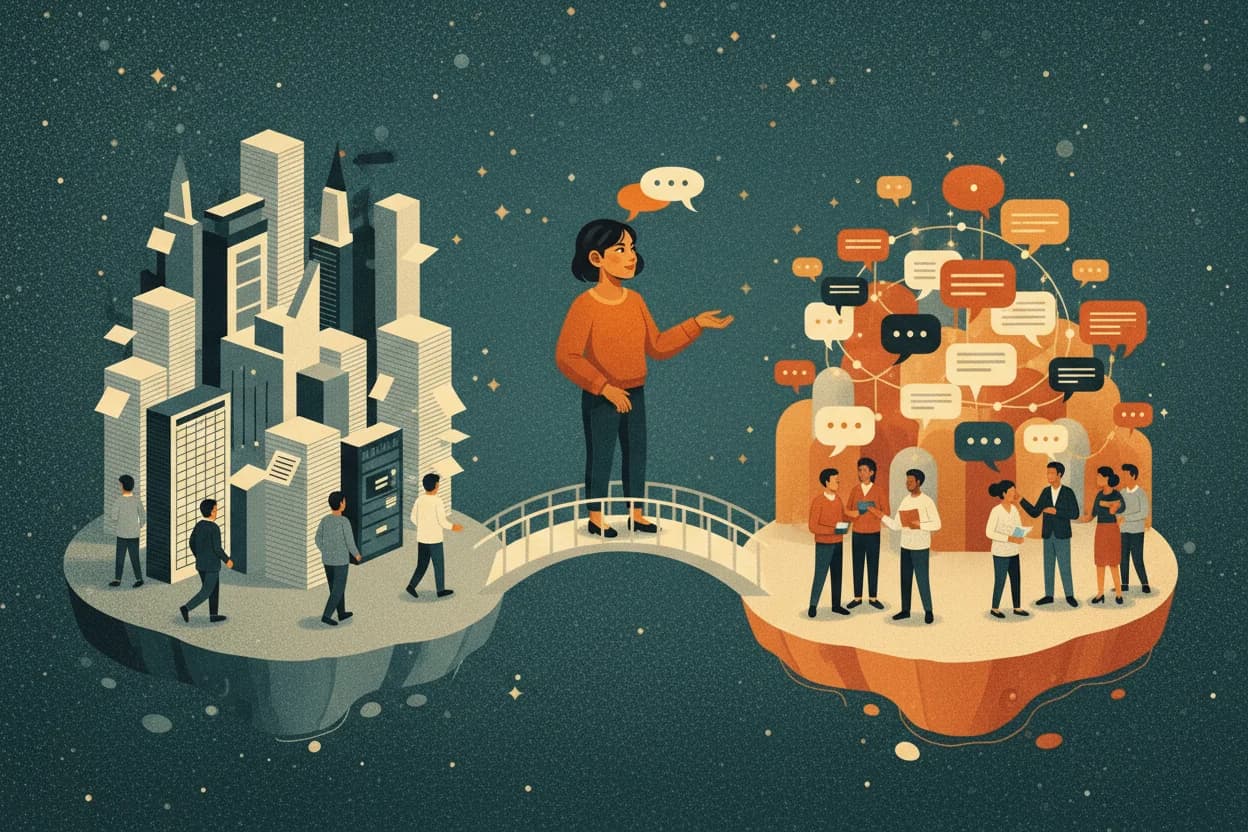
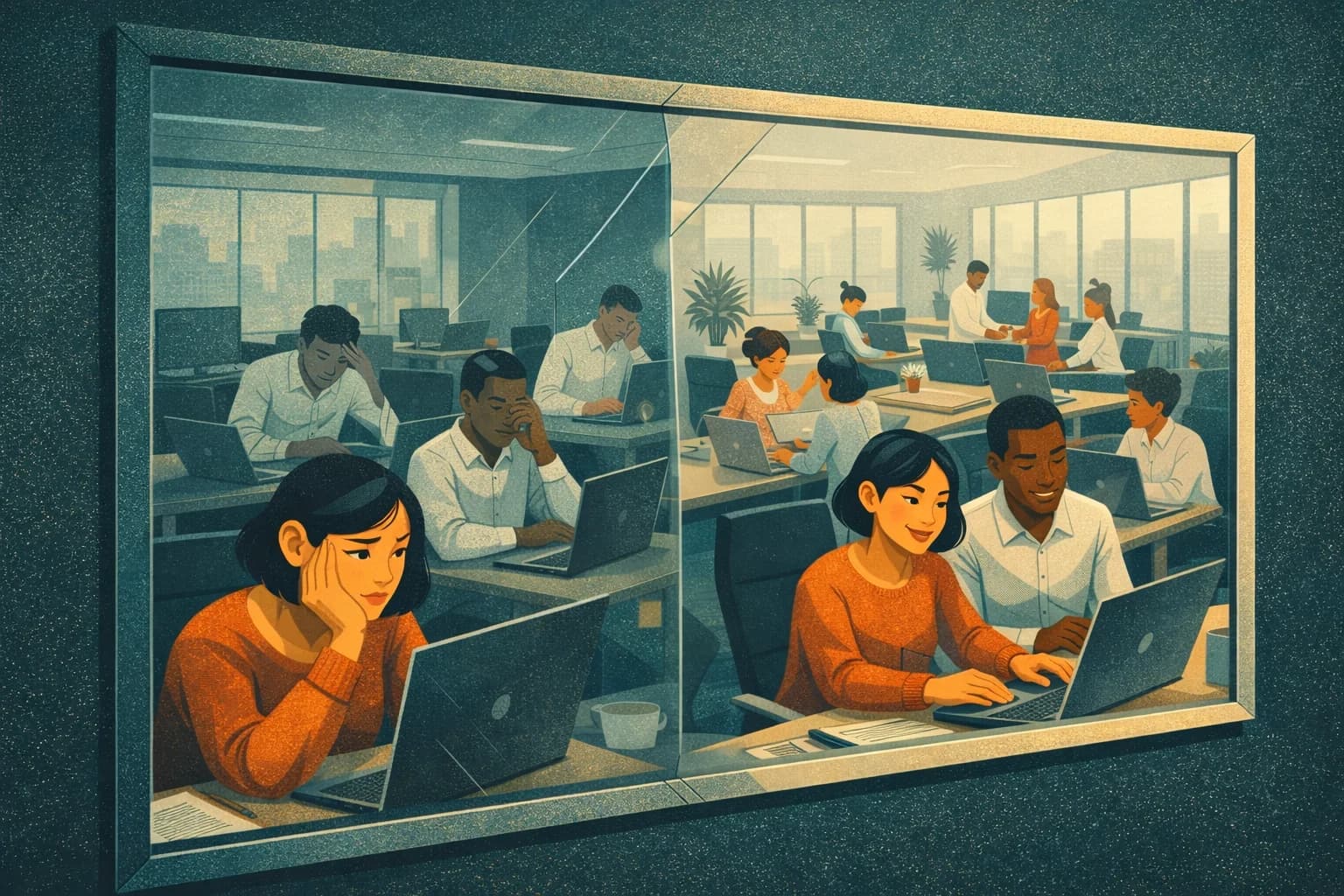
This company is not an outlier. Of every 50 AI investments, only one delivers measurable transformative value, according to Gartner – not because the technology fails, but because organizations overlook how the people behind the screens actually experience the change. In early 2026, Gartner coined a term for this that features prominently in their nine future-of-work trends: Culture Dissonance. It describes the growing gap between what a company promises outwardly and what employees actually experience on the ground.
In the context of AI, this gap widens especially fast because companies demand more from their teams without giving more in return: no better compensation, no flexibility, no genuine involvement in the transformation.
Key takeaways: Only 1 in 50 AI investments delivers transformative value (Gartner 2026). 70% of AI projects fail because of culture, not technology. Culture Dissonance – the gap between promise and reality – is the top risk of 2026. Continuous Listening with AI-powered interviews makes this gap measurable.
What Is Culture Dissonance?
Definition: Culture Dissonance describes the growing gap between a company's proclaimed culture and the culture its employees actually experience. The term was coined by Gartner in 2026.
Gartner analyst Kaelyn Lowmaster puts it plainly: Culture Dissonance emerges when the culture no longer reflects the reality of work. At first, that sounds like garden-variety change resistance, but it runs deeper. Resistance to change can be softened with good communication and participation. Culture Dissonance cannot, because it strikes at identity and belonging. The question shifts from "Do I want to be part of this?" to "Do I still belong here?"
What this looks like in practice: a team lead in customer service who spent years building expertise in complex complaint cases. Now an AI chatbot is supposed to handle first-line resolution, and the official message is, "You get to focus on the really difficult cases." What she actually experiences is something else – her case numbers are dropping, her role is shrinking, and nobody asked her whether the chatbot is filtering the right cases. It isn't, but leadership won't notice until months later, when customer complaints start rising.
Gartner observes that a growing number of companies are imposing a startup culture with long hours, aggressive performance management, and minimal flexibility, without offering better compensation or benefits in return. The gap between expectation and reality is growing, and it's growing fast. Gartner calls the consequence "Regrettable Retention": employees remain physically present in the company but have mentally checked out – they show up, do the bare minimum, and deliver just enough to stay under the radar. For leaders, this is more insidious than actual turnover, because the attrition numbers look stable and everything appears fine on the surface. Underneath, though, productivity declines, quality suffers, and the capacity for innovation fades – invisibly, until it shows up in the business results. By then, it's usually too late.
What Do the Numbers Say About the AI Culture Crisis?
Just how large this problem really is becomes clear when you look at three recent studies – and their findings, taken together, tell a story more troubling than any single data point.
Gallup's State of the Global Workplace Report 2025, which surveyed nearly 250,000 workers across 160 countries, puts global engagement at 21 percent – the lowest since the COVID lockdowns of 2020. Two percentage points less than the year before, which sounds abstract until you scale it up: across a global workforce of billions, that represents hundreds of millions of people who feel disconnected from their work, and $438 billion in lost productivity. What's especially alarming is where the decline hits hardest – not at the frontline, but among leaders. Manager engagement dropped from 30 to 27 percent, among young managers under 35 by five percentage points, among female leaders by seven. Why that's so dangerous is illustrated by another Gallup figure: 70 percent of the variance in team engagement traces directly back to the manager. When the people who are supposed to lead others are themselves disengaged, the rest inevitably follows.
That AI is fueling this trend further is confirmed by BCG's AI at Work Report 2025, surveying over 10,600 respondents across eleven countries. In companies with extensive AI transformation, 46 percent of employees worry about their job security – compared to just 34 percent in companies with less AI adoption. The closer AI gets, the greater the fear. Surprisingly, it hits leaders even harder: 43 percent of managers fear losing their job within ten years – more than their own team members at 36 percent. Making matters worse is a training gap that few are willing to address openly: only about a third of employees consider AI training sufficient, and 18 percent of regular AI users have received no training at all. The tool exists, the expectation to use it exists – but adequate enablement does not.
Gartner's own assessment is sobering: only 1 in 50 AI investments delivers transformative value, and only 1 in 5 delivers any measurable return at all. Despite this, CEOs have already cut headcount on the strength of these promises – even though, according to Gartner data, fewer than 1 percent of layoffs in the first half of 2025 were actually driven by AI-related productivity gains. The rest was an advance on a future that hasn't arrived yet. The employees who stayed know this – and they're drawing their own conclusions.
The flip side of these numbers is the potential being left on the table: Gallup calculates that organizations worldwide could unlock $9.6 trillion in additional productivity – roughly 9 percent of global GDP – if they could reach the engagement levels of the best-performing organizations. The leverage is enormous, yet almost nobody is reaching for it.
How Do You Recognize Culture Dissonance?
Culture Dissonance rarely shows up in a single metric. It distributes itself across patterns that seem harmless in isolation but paint a clear picture when seen together.
Workslop. Gartner coined this term for a phenomenon that has already become daily reality in many organizations: AI output is rising, but the quality of work is falling with it. The marketing team has been producing twice as many blog posts since the Copilot rollout – yet traffic has actually dropped, because the content sounds generic and readers notice. What gets sold as a productivity gain often turns out to be a shift in practice: instead of better work, you get more work, because employees spend their time fixing bad AI output. Gartner calls Workslop the biggest productivity killer of 2026, and Emily Rose McRae, Senior Director Analyst at Gartner, recommends a shift in perspective: the best CHROs should point AI at the most tedious, friction-filled moments of work, not at quick volume gains – saving effort, not just time.
Quiet Quitting 2.0. The engagement scores look stable, but the best people are leaving – or worse, they stay and deliver only the bare minimum. The seasoned product developer who used to bring three ideas to every meeting now sits in silence, waiting for someone to sign off on the AI output. That's Regrettable Retention in practice, and it doesn't surface in standardized surveys because the questions aren't designed to distinguish inner resignation from ordinary satisfaction. Gallup's data confirms the picture: individual contributors hold steady at 18 percent engagement – stable, but at a level that can only be described as chronically disengaged.
Manager Burnout. Leaders are caught in a sandwich between AI pressure from above and team anxiety from below. The department head is supposed to simultaneously implement the new AI workflows, absorb her team's concerns, and hit her quarterly targets – with fewer people than before. That manager engagement has dropped from 30 to 27 percent, according to Gallup, is hardly surprising under these conditions. And less than half of all managers worldwide have ever received any management training at all, let alone one that prepares them to lead through an AI transformation.
Training Illusion. Training programs exist, but they don't go far enough: only about a third of employees, according to BCG's AI at Work Report, consider AI training adequate. The typical scenario is a half-day workshop demonstrating how to write prompts – after that, everyone's on their own. But the difference between "being able to operate a tool" and "understanding how it changes my work" is vast: a two-hour workshop on prompt engineering prepares nobody for the reality that their entire job description is fundamentally shifting. The contrast is revealing: those who received more than five hours of training use AI significantly more regularly and productively, according to BCG – 79 percent versus 67 percent with shorter training. More investment in enablement demonstrably pays off, yet it remains the exception.
Top-Down Mandates. AI gets rolled out without asking the teams. No pilot projects with feedback loops, no collaborative development of use cases – just an email from the executive suite: "Starting next week, we're all using Copilot. Please watch the training videos on the intranet." That's the opposite of psychological safety, and how the workforce responds is captured by a BCG figure that should give pause: more than half of employees say they would resort to unauthorized AI tools if the official ones don't work or aren't accessible. Among Millennials and Gen Z, it's 62 percent. Shadow AI, in these cases, isn't a sign of resistance – it's a sign of demand without supply.
Why Do Traditional Employee Surveys Fail?
Most organizations rely on annual employee surveys to take the pulse of their workforce. That was already questionable before AI – in the context of an AI transformation, it borders on negligent.
The most obvious problem is frequency: once a year is like taking the temperature of someone who's been sick for months. By the time the results are analyzed, presented, and translated into action items, another few months have passed. In an AI transformation where roles and processes shift within weeks, every insight arrives too late.
Equally serious is the lack of depth. "How satisfied are you on a scale of 1 to 10?" measures a symptom, not a cause. A 6 can mean: "It's fine, nothing special." It can also mean: "I'm terrified of losing my job, but I don't dare say so." Scale-based questions don't distinguish between indifference and suppressed desperation – they give you a number, but not the story behind it.
Then there's the anonymity paradox: employees trust anonymous surveys far less than HR departments assume. Anyone working in a five-person department knows that five responses are easily traceable. Nobody checks "I'm afraid of AI" when leadership is presenting the AI strategy as the grand vision for the future. The result is data that reassures everyone and informs no one.
And finally, the blind spot that weighs heaviest in the AI context: standard surveys measure whether AI is being used, not how the experience of using it feels. They capture tool adoption, not emotional response. They ask about satisfaction, not about the moment when the customer service team lead noticed her case numbers shrinking and no one asked for her assessment.
| Aspect | Annual Survey | Continuous Listening |
|---|---|---|
| Frequency | Once per year | Continuous |
| Depth | Scale-based questions | Open conversations |
| Response time | Months | Days |
| Root cause analysis | Minimal | Theme extraction |
| AI-specific insights | None | Targeted and steerable |
What Is Continuous Listening and Why Is It Better?
Continuous Listening is not the same thing as "more surveys, more often." It means a permanent, qualitative dialogue with your workforce – not more questions on a scale, but better conversations with open-ended responses.
The critical difference lies in the quality of insight. When you ask someone, "How are you experiencing the AI rollout in your day-to-day work?", you get stories, emotions, specific situations: that the sales director hates the CRM tool because it takes over work he considered his core competency. That the marketing team is secretly using ChatGPT because Copilot is useless for their use cases. Or that three departments share the same problem with the new workflow, but nobody is aggregating the data because each department runs its own pulse survey.
The problem with qualitative conversations has always been scalability: 30 in-depth interviews take weeks, cost five figures, and deliver insights that are outdated before they're even presented. A researcher can handle four or five interviews per day, after which come transcription, coding, analysis – for a company with 2,000 employees, you'd need months.
This is exactly where AI changes the equation. Not as a replacement for human judgment, but as a tool to make qualitative depth possible at scale: AI conducts the conversation, transcribes in real time, and identifies themes across hundreds of interviews, while humans interpret the results and decide on action. If you want to go deeper, our article on AI-powered employee interviews walks through concrete examples.
BCG provides compelling evidence for this: when leaders actively champion AI and communicate transparently, positive AI sentiment among employees jumps from 15 to 55 percent – a 40-percentage-point increase from better communication alone. However, only a quarter of frontline employees say their leaders genuinely support the technology. Continuous Listening creates the data foundation to understand where this communication is lacking and which teams already have strong approaches that others can learn from.
How Do AI-Powered Interviews Make Culture Dissonance Visible?
Back to the company in southern Germany. Leadership wants to understand why morale has tanked, but the annual survey isn't due for another four months, and a pulse survey only delivers the usual scale ratings. What's missing are the stories behind the numbers.
An AI-led interview works differently: employees open a link, start a conversation, and respond to open-ended questions while the AI asks adaptive follow-ups based on what's been said. No questionnaire, no checkboxes – a real conversation with the depth of a one-on-one interview, but scalable to hundreds or thousands of participants.
What becomes visible through this process is something no scale-based question can capture:
The clerk in accounting describes how, since the AI rollout, he feels like he's only reviewing results that he used to produce himself – like a quality inspector of his own obsolescence.
The project lead in engineering reports that her team uses the new AI assistant for documentation, but the output is so generic she has to rewrite everything. Net-net, it costs her more time than before.
The marketing apprentice thinks the tools are fantastic and is producing three times as much as a year ago. What he doesn't see: his boss hasn't contributed a single original idea in three months because he's questioning what his 15 years of experience are still good for.
After the conversations, automated analysis follows: theme extraction across all interviews, sentiment detection, pattern identification. Which departments are experiencing Culture Dissonance? Where is the AI rollout working well, and what distinguishes the teams that are thriving from those that are struggling?
At QUALLEE, this is exactly what we do: AI conducts the interview, transcribes automatically, and delivers an initial thematic structure, while you invest your time in interpretation and action rather than data collection. It scales from 20 to 2,000 conversations, across five languages and fully GDPR-compliant – from the first question to the thematic overview, it takes hours, not weeks.
What Does the EU AI Act Mean for Employee Surveys?
Starting August 2026, the EU AI Act takes full effect, and AI systems involved in HR decisions are classified as "high-risk." This covers recruiting, performance management – and potentially employee listening too, if the results influence personnel decisions. In practical terms, that means: bias audits, human oversight, documentation of decision-making, and informing those affected. The penalties are substantial: up to 35 million euros or 7 percent of global annual revenue.
For companies using AI-powered employee surveys, Privacy by Design becomes a competitive advantage: those who build GDPR-compliant processes now won't have to retrofit under time pressure two years from now. We've covered this topic in depth in a dedicated article.
How to Measure and Fix Culture Dissonance in 90 Days
Recognizing Culture Dissonance is the first step, but awareness alone changes nothing. Here's a pragmatic roadmap for the first 90 days.
Phase 1: Listen (Day 1–30)
Start with AI-powered interviews involving 20 to 30 employees from different teams and levels of the hierarchy. This isn't about a statistically representative sample – it's about qualitative depth. What matters are patterns, not percentages.
Breadth is important: don't just interview the most vocal or the most satisfied. Deliberately include teams considered critical and those known as frontrunners, because you need both perspectives to identify patterns.
Open-ended prompts that surface Culture Dissonance:
- "How are you experiencing the AI rollout in your day-to-day work?"
- "What has concretely changed for you over the past few months?"
- "What's on your mind that you haven't talked about yet?"
- "When was the last time you felt your experience and expertise were truly valued?"
- "If you could tell leadership one thing they don't want to hear – what would it be?"
These questions work because they don't ask about satisfaction on a scale; they ask about specific experiences, feelings, and moments. Automated theme extraction generates initial patterns from these – not finished answers, but hypotheses that can be tested.
Phase 2: Understand (Day 31–60)
Now it's about identifying patterns: which teams are experiencing Culture Dissonance? Where is the AI rollout working well, and what are those teams doing differently? When the same concerns surface across multiple departments – despite them working with entirely different tools – that points to a cultural problem, not a technical one.
Share the findings with leaders – not as an accusation, but as a diagnosis. Culture Dissonance isn't a failure of leadership; it's a systemic phenomenon that can hit any organization mid-transformation. The question isn't who's to blame, but what helps now.
Deeper follow-up prompts for the second round:
- "What would need to happen for you to experience AI tools as genuine support?"
- "In which situations do you still feel effective at work – and in which do you no longer?"
- "What do you need from your manager that you're currently not getting?"
Identify quick wins: what can be changed immediately? Often it's things that get lost in the daily grind – a team needs better training, a department was bypassed in the tool selection process, a manager never explained why the change is happening. These are solvable problems, if you know about them.
Phase 3: Act (Day 61–90)
Implement targeted measures: adapt training, improve communication, involve teams in decisions. Not everything at once, and not with a big program – small, visible changes carry more weight than announcements that lead to nothing.
A concrete example: the company in southern Germany discovered after the first round of interviews that product development had the biggest Workslop problem. The solution wasn't more training but less tool mandating: the team was allowed to decide for itself which tasks benefited from AI and which didn't. Three weeks later, documentation quality was back to its previous level – with less time spent than before the AI rollout, because teams were using the tool selectively rather than across the board.
Then come the follow-up interviews: has anything changed? Do employees feel heard?
Follow-up prompts:
- "Has anything changed since our last conversation? What specifically?"
- "Do you feel your feedback was heard and acted on?"
- "What's the one thing you'd wish for over the next three months?"
The second and third rounds are often more revealing than the first, because employees notice that someone is actually listening – and open up more as a result.
The most important step, however, comes at the end: establishing Continuous Listening as an ongoing process, not a one-time initiative. Culture Dissonance isn't a problem you solve once – it can resurface whenever conditions change. And in an AI transformation, conditions change constantly.
Frequently Asked Questions
What is Culture Dissonance?
Culture Dissonance describes the gap between a company's proclaimed culture and the culture employees actually experience. The term was coined by Gartner in the context of its Future of Work Trends 2026. Culture Dissonance emerges when organizations demand more from their employees without giving more in return – for instance, during an AI rollout that promises productivity gains but offers neither guidance nor recognition.
Why do AI projects fail because of company culture?
According to Gartner, only 1 in 50 AI investments delivers transformative value. The most common reason isn't technical failure but a lack of acceptance and insufficient cultural support. When employees don't feel included, they either don't use AI tools at all or use them only superficially – producing what Gartner calls "Workslop."
What is Regrettable Retention?
Regrettable Retention describes the phenomenon of employees who remain physically present but have mentally checked out. They go through the motions, show no initiative, and over time erode the company's culture and employer brand. Gartner sees Regrettable Retention as a direct consequence of Culture Dissonance.
What is Workslop?
Workslop is a term coined by Gartner for the flood of rapidly produced but poor-quality output that results from uncritical AI usage. Teams are pressured to use AI everywhere but lack the time for quality control. Gartner calls Workslop the biggest productivity killer of 2026.
How do employee surveys differ from Continuous Listening?
Traditional employee surveys happen once or twice a year and rely on scale-based questions. Continuous Listening is a permanent qualitative dialogue with the workforce that uses open conversations and identifies patterns over time. The critical difference: Continuous Listening captures not just symptoms, but root causes.
How can AI-powered interviews improve culture measurement?
AI-powered interviews conduct open conversations with employees, ask adaptive follow-up questions, and analyze responses automatically. They surface themes that scale-based questions miss: fears, frustrations, specific suggestions for improvement. Results can be aggregated across hundreds of conversations and visualized as patterns.
What does the EU AI Act mean for employee surveys?
Starting August 2026, AI systems involved in HR decisions are classified as "high-risk" under the EU AI Act. This potentially applies to AI-powered employee listening systems when their results influence personnel decisions. Companies must ensure bias audits, human oversight, and proper documentation.
Culture Dissonance Is Measurable – If You Ask the Right Questions
Gartner, Gallup, and BCG paint a clear picture for 2026: the greatest danger of AI transformation isn't the technology, but the gap between what companies promise and what employees experience. The customer service team lead whose expertise is shrinking; the product developer who's stopped contributing ideas; the department head being ground down between AI pressure and team anxiety – their stories don't show up in any scale-based question.
This gap can't be closed with annual surveys. It demands real conversations, continuously conducted and systematically analyzed. Those who recognize Culture Dissonance early can course-correct before the best people leave and everyone else starts going through the motions.
The good news: listening has never been more scalable than it is today.
Sources
- Gartner: Top Future of Work Trends for 2026
- HBR: 9 Trends Shaping Work in 2026 and Beyond
- Gallup: State of the Global Workplace Report
- BCG: AI at Work -- What People Are Really Saying
Experience It Yourself
Want to know what an AI-led interview actually feels like? Start a test interview and experience firsthand the depth an open conversation creates – compared to a scale from 1 to 10.