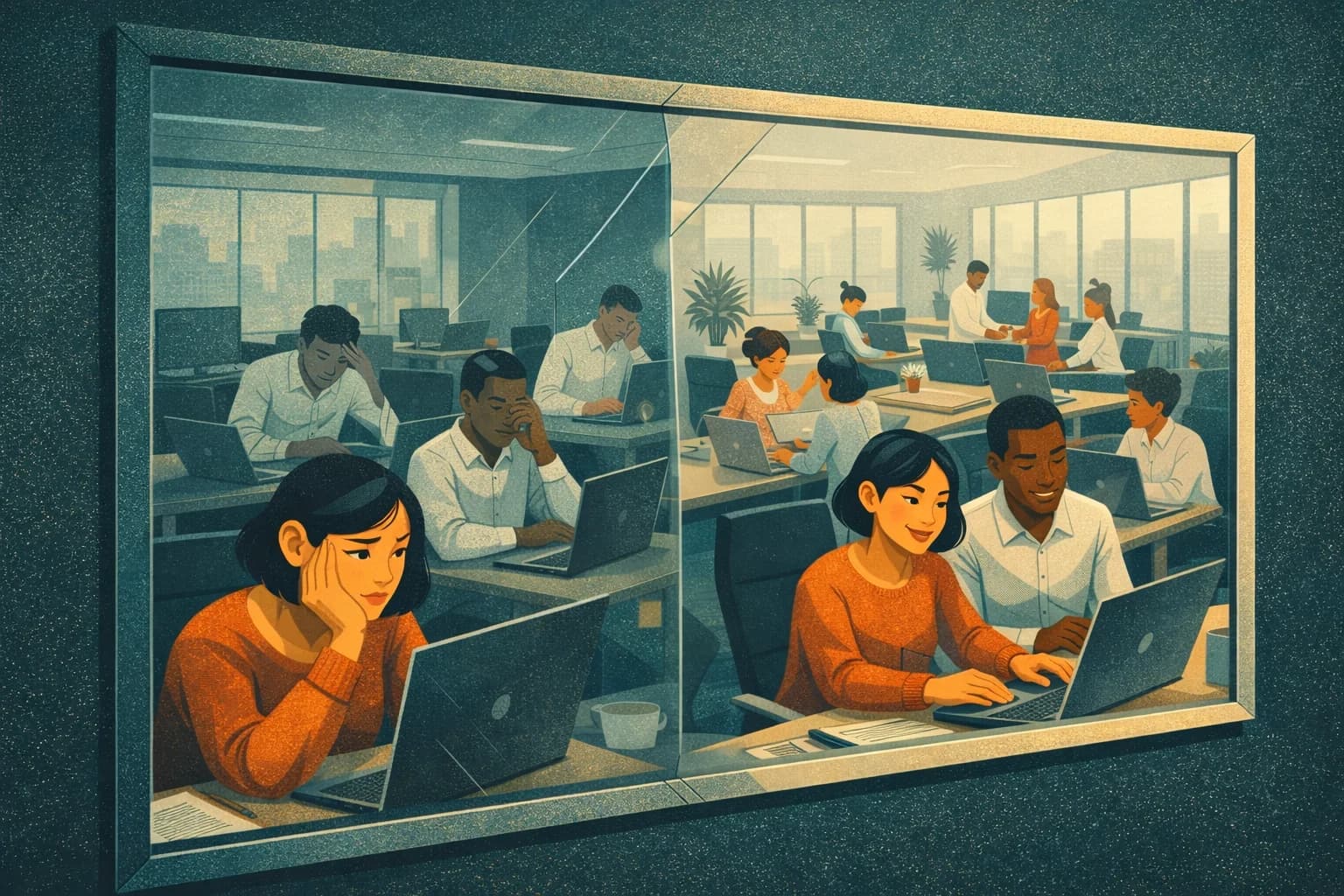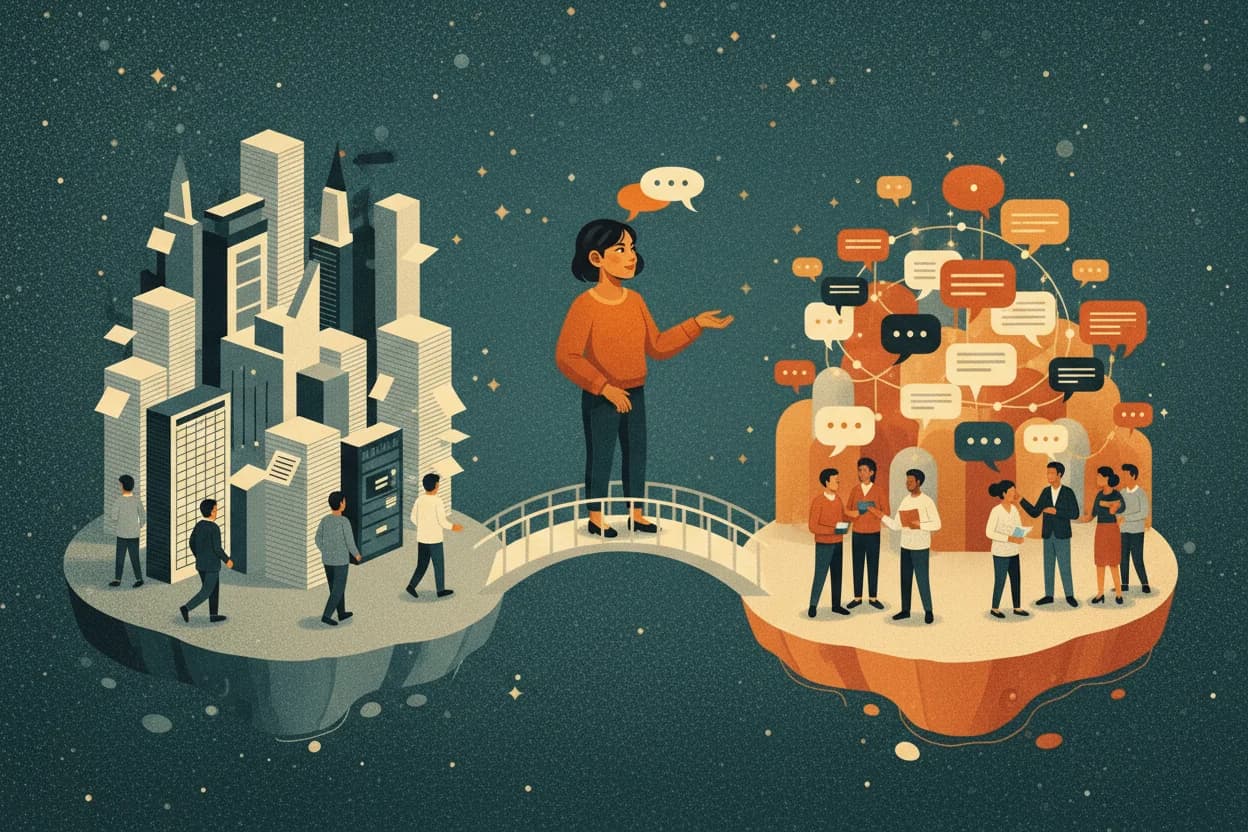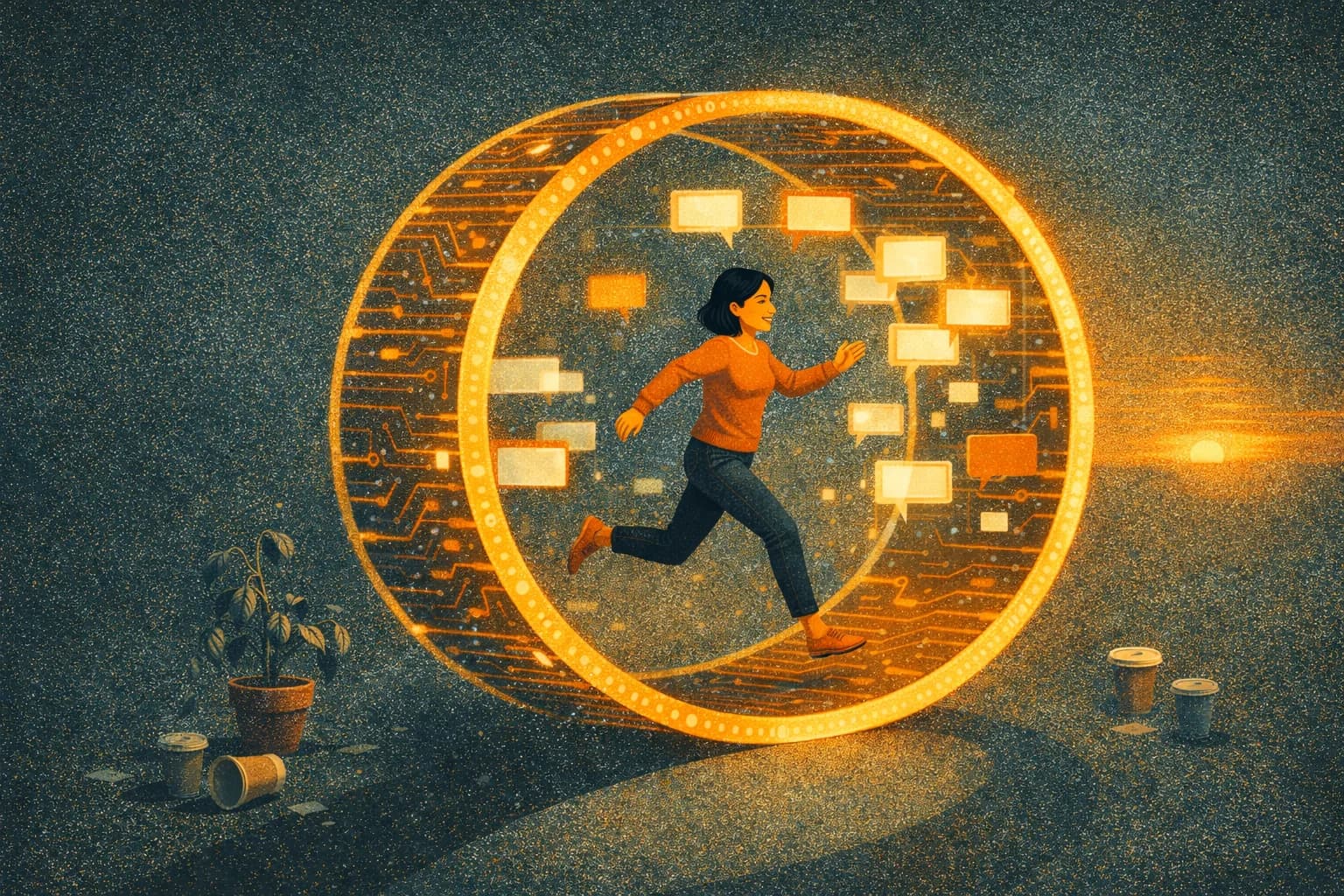
Generative AI was supposed to make work easier. Less routine, more time for what actually matters. That was the promise. The reality looks different: in a study published in the Harvard Business Review in February 2026, Aruna Ranganathan and Xingqi Maggie Ye from the UC Berkeley Haas School of Business show that AI tools don't reduce work — they compress it. Faster pace, more tasks, fewer breaks, creeping exhaustion.
This aligns with what the Workforce Trends Report 2026 by DHR Global shows: 52 percent of all employees now say that burnout is reducing their engagement — the year before, it was 34 percent, an increase of more than half in twelve months. 83 percent experience at least some degree of burnout; the leading causes are overwhelming workloads (48 percent) and too many hours (40 percent).
Two studies, the same picture: AI is making work harder, not easier.
200 intrinsically motivated people who genuinely wanted AI
What makes the Berkeley study remarkable is its setting. The researchers spent eight months embedded in a US tech company with roughly 200 employees — two days a week on-site, reading internal Slack channels, conducting over 40 in-depth interviews across engineering, product, design, research, and operations.
The crucial point: the company had provided AI tools but never mandated their use. No management directive, no KPIs for AI adoption, no pressure. Those who used the tools did so on their own initiative. 200 intrinsically motivated people who saw AI as an opportunity and voluntarily integrated it into their daily work.
And that is exactly what makes the results so uncomfortable. Because these people — the enthusiasts, the early adopters, the ones every company wishes it had more of — didn't work less. They worked more. Not a little more, but structurally differently: faster cadence, broader task scope, fewer boundaries between work and non-work. The researchers call it "intensification" and describe three mechanisms that feed on each other.
Mechanism 1: When everyone suddenly does everything
The first mechanism: people take on tasks that aren't theirs. Product managers start coding. Researchers close engineering tickets. Designers write database queries. Not because anyone asks them to, but because AI lowers the barrier to entry so far that it feels like you can just give it a try.
And you can try. That's the seductive part. AI gives instant feedback, corrects mistakes, suggests next steps. In a domain where you were helpless yesterday, you suddenly feel competent. It's a genuine cognitive kick — almost a high.
But in aggregate, the scope of every individual job balloons. Tasks that used to go to specialists, or for which you would have hired additional people, get absorbed — by people who, on top of their actual job, are now also doing things they were neither trained for nor scheduled to do. Nobody adjusts job descriptions or reduces the original workload; the new tasks simply pile on top.
This creates a domino effect: the results of all that experimentation eventually have to be reviewed by someone. In the study, it was the senior engineers who increasingly spent their days reviewing half-finished pull requests and vibe-coding artifacts from their colleagues. Not in formal code reviews, but on the side: in Slack threads, in quick desk conversations, squeezed between their own tasks. The most experienced people on the team become the quality filter for work that didn't exist before.
Mechanism 2: Work becomes something that's always there
The second mechanism is subtler, and perhaps more dangerous for that reason. AI makes the on-ramp to any task frictionless. No blank page, no unfamiliar starting point. One prompt is enough.
That sounds like efficiency. In practice, it means every gap in the day becomes fillable. Lunch break, waiting time before a meeting, the moment before leaving in the evening. "Let me just fire off a quick prompt so the AI can work while I'm away." It takes 30 seconds and doesn't feel like work, because prompting feels more like chatting than a formal work step.
But those 30-second moments add up. After a few weeks, you have a workday without natural breaks. The lunch break becomes a prompt session. The end of the workday starts with "let me just check the output real quick." Sunday evening becomes the moment where you "get a head start on something," because it's so fast.
Several respondents in the study described realizing only weeks or months later what had happened. The recovery phases had eroded — gradually, imperceptibly. Work was no longer something you did at certain times but something that was always running in the background. Not intrusive, not stressful, just: always there. The boundary between work and non-work hadn't disappeared, as the researchers write, but had become easier to cross.
Mechanism 3: Too many balls in the air
The third mechanism concerns the way AI-assisted work is organized. With AI, multiple threads are always running in parallel. You code by hand while the AI generates an alternative; you start three tasks simultaneously because the AI can work on two of them "in the background"; you revive long-shelved projects because they suddenly seem doable.
This creates the feeling of having a partner. Someone working alongside you while you do something else — a feeling of momentum and throughput.
The reality is different: constant context switching, perpetual output checking, a to-do list that only grows. We aren't multitaskers but task-switchers, and every switch costs cognitive energy. Over the course of a day, these micro-costs accumulate into deep mental exhaustion.
There's also a social effect. When everyone on the team delivers faster, the norm shifts. Not through a top-down announcement, but through what becomes visible and normal. When you see colleagues working on three tasks in parallel, you feel implicit pressure to do the same. Speed becomes an expectation, even if nobody says it out loud.
The spiral that turns by itself
These three mechanisms don't exist side by side. They amplify each other into a spiral: AI accelerates tasks, which raises implicit expectations for speed; higher expectations increase dependence on AI; greater dependence broadens scope, because you take on more and more yourself. Broader scope creates more work that needs to be done faster. The spiral keeps turning.
An engineer from the Berkeley study: "You thought you'd save time and work less. In reality, you work just as much or even more."
The respondents felt more productive, but not less busy — quite the opposite. And from the sixth month of the study onward, reports of exhaustion, anxiety, and decision paralysis began to pile up. What looked like a productivity miracle in the first quarter produced quality problems and the first departures in the third.
The insidious thing about this cycle is that it disguises itself as progress. You can suddenly do things that seemed impossible before; you deliver more; you get praised. It doesn't feel like overload — it feels like empowerment. Until it tips.
Accenture: What happens when you force AI adoption
The Berkeley study shows one extreme: AI use that voluntarily becomes too intense. Accenture shows the other.
The consulting giant, with nearly 800,000 employees, has been tracking the weekly AI tool logins of its senior staff since February 2026 and making them a criterion for promotion. "Usage of our key tools will be a visible input for talent discussions," reads an internal email seen by the Financial Times. Among the tools being monitored are the in-house AI Refinery and SynOps. Employees in twelve European countries are exempt from the policy, as are those working on US government contracts.
The reaction from within the ranks is telling. Two people familiar with the measure described some of the tools to the Financial Times as "broken slop generators." One person said they would "quit immediately" if the rule applied to them. The company cut roughly 11,000 jobs in the past year, spent nearly $2 billion on severance, rebranded its workforce as "Reinventors," and CEO Julie Sweet announced that those who can't adapt will have to leave.
Here lies a fundamental problem: Accenture advises other companies on how to execute AI transformation. Three executives from Big Four consulting firms independently confirmed to the Financial Times that it is harder to get senior managers and partners to adopt AI than junior employees. The people selling transformation resist it the hardest themselves.
Accenture's solution is surveillance and pressure. The result is predictable: compliance theater. People log in to make the counter tick, not because they work better. The stock price has dropped 42 percent in twelve months, from over $260 billion to roughly $137 billion in market capitalization. Perhaps a conversation with their own people would have been cheaper than a surveillance policy.
Both scenarios — voluntary overuse and forced adoption — are symptoms of the same mistake: organizations treat AI adoption as a technical question (Do people have access? Are they using the tools?) when it's a deeply human one (How does AI change the way people work, think, and recover?).
Three measures against AI burnout for HR teams
The Berkeley researchers recommend what they call an "AI Practice": deliberate ground rules for how, when, and how much work is done with AI. That sounds abstract. In concrete terms, it breaks down into three levers.
Build in deliberate pauses. Not as a wellness initiative, but as quality assurance. The researchers suggest that before every important decision, at least one counterargument and an explicit connection to business objectives must be articulated. That takes five minutes and prevents speed from replacing judgment. In practice, it means AI-assisted deliverables get a mandatory reflection step before they move forward.
Sequence work instead of parallelizing it. Don't react to every AI output immediately; instead, batch updates, shift notifications to natural breakpoints, protect focus windows. Instead of constant reactivity, establish a rhythm of concentrated work and deliberate review. This reduces the context switching that, according to the study, is one of the primary drivers of cognitive exhaustion.
Protect human grounding. AI enables more and more solo work. You no longer need to ask a colleague — you ask the AI. That saves time, but it also eliminates the conversations where perspectives collide and creative ideas emerge. Organizations that don't deliberately create space for human exchange risk teams that work faster but think worse.
Why engagement surveys can't detect AI burnout
Most HR teams measure with Likert scales, Net Promoter Scores, and quarterly pulse checks. These instruments capture whether someone is satisfied. They don't capture why someone can be enthusiastic and exhausted at the same time.
But that is exactly what the Berkeley study shows. People didn't say "I have too much work." After all, they had voluntarily taken on more, and it had felt good. Until it didn't. This paradox — empowerment and exhaustion as two sides of the same experience — cannot be captured on a five-point scale.
To understand what's really happening, you need qualitative data. You need to actually talk to people.
The problem: 40 in-depth interviews like in the Berkeley study mean weeks of fieldwork, five-figure costs, months until the report. The researchers were on-site two days a week for eight months. What HR team has those resources?
AI-powered interviews as a way out of the measurement dilemma
The tool that causes the problem can also help make it visible — if used the right way.
QUALLEE conducts qualitative interviews with AI. An AI asks questions, listens, probes, follows the conversational thread. Real people respond, at their own pace, in their own words. The analysis distills patterns from dozens or hundreds of these conversations — in hours instead of months.
For HR teams that want to understand the AI burnout effect in their own organization, these are the questions no engagement survey can reach: How has your workday changed because of AI? When does AI use feel productive, and when does it tip? Are you doing things on weekends that you wouldn't have done six months ago? What do you need for AI use to stay sustainable?
No Likert scale answers that. A conversation does.
Try it yourself
The Berkeley study ends with a clear statement: without deliberate countermeasures, AI-assisted work doesn't lead to relief but to compression. The first step isn't counting logins like Accenture or hoping things will work out — the first step is listening.
Frequently asked questions
What is the AI Burnout Paradox?
The AI Burnout Paradox describes the phenomenon that AI tools don't make work easier — they compress it. A UC Berkeley study from 2026 shows that people who voluntarily and enthusiastically use AI don't work less, they work more. The intensification arises through three mechanisms: task scope expansion, blurring of the boundaries between work and personal time, and chronic multitasking.
What did the UC Berkeley study 2026 find?
Researchers Aruna Ranganathan and Xingqi Maggie Ye spent eight months observing 200 intrinsically motivated employees at a US tech company. Without any mandate to use AI, these people worked structurally more: broader scope, fewer breaks, constant context switching. From the sixth month onward, exhaustion, anxiety, and decision paralysis increased. The study was published in the Harvard Business Review in February 2026.
Why can't engagement surveys detect AI burnout?
Traditional instruments like Likert scales and pulse checks measure satisfaction on a scale. They cannot capture why someone can be simultaneously enthusiastic and exhausted. The AI Burnout Paradox manifests as empowerment, not dissatisfaction, and therefore evades quantitative metrics. Qualitative interviews are needed to make the actual changes in daily work visible.
What can HR teams do about AI burnout?
Three concrete measures: first, build in deliberate reflection pauses before AI-assisted decisions. Second, sequence work instead of parallelizing it to reduce context switching. Third, protect space for human exchange so that teams don't just work faster but also think better. The Berkeley researchers call this an "AI Practice": deliberate ground rules for working with AI.
What does Accenture have to do with AI burnout?
Accenture has been tracking the AI tool logins of its senior employees since February 2026 and making them a criterion for promotion. Employees internally described the tools as "broken slop generators." The case illustrates the opposite of the Berkeley study: forced adoption instead of voluntary overuse. Both scenarios carry burnout risks because AI adoption is treated as a technical question rather than a human one.