
The most honest answer in a person's working life usually comes in the last conversation: the exit interview, once the paperwork is signed and there is nothing left to lose. Everything said there is valuable - and completely useless for that particular person. They are already gone.
In 25 years of project work I have seen a lot of teams from the inside, and one pattern repeats reliably: organisations invest remarkable care in analysing resignations and remarkably little in the question of why the people who stayed are still there. The exit interview is the autopsy. It explains precisely what the patient died of. It just cannot treat them any more.
What are stay interviews? A stay interview is a structured one-to-one conversation with the people you want to keep - about what holds them, what wears them down and what would make them leave. It happens before the resignation is on the table. In practice it fails on three things: the power gap to the interviewer, the time managers do not have, and the analysis. AI-led interviews solve all three, provided you know their limits.
The numbers have been an imposition for years
The Gallup Engagement Index Germany 2025 measures what leaders would rather not hear: only 10 percent of employees feel highly emotionally committed to their employer, 77 percent do the minimum required, and 13 percent have already quit internally. By Gallup's calculation, that internal resignation costs the German economy between 119 and 142 billion euros a year.
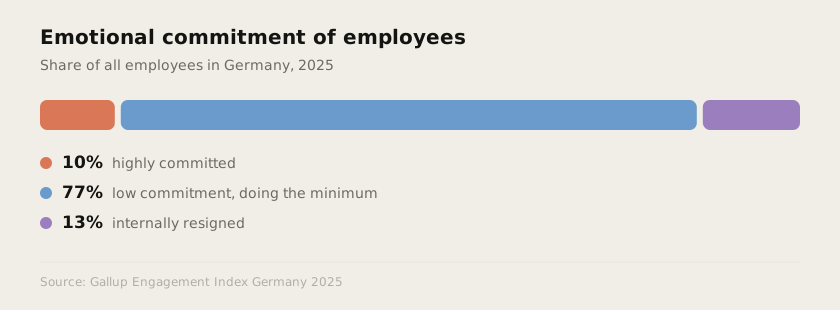
So nine out of ten people in German offices work for an employer who means little to them emotionally. The seemingly good news, that more people want to stay again, is qualified by the report itself: 74 percent rate their chances on the job market as good or very good. People are not staying because they are convinced. Many are staying because the environment currently feels unsafe.
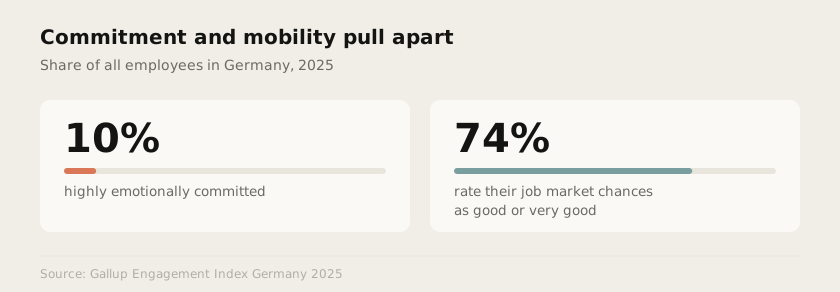
That gap is the actual finding. It describes a workforce that stays without being committed - and that leaves the moment the labour market picks up again.
What an unexpected resignation costs, anyone can estimate for themselves: recruiting, onboarding, the months when nobody fills the role, the knowledge that walks out with them. Anyone who has sat in a team the week after a key person resigned does not need a study for that.
Most companies answer this situation with a tool that structurally does not fit: the annual employee survey. Why it measures mood instead of causes, I have described in detail here. That the format as a whole is reaching its limits is a topic of its own. For the retention question there is a second problem: an anonymous one-to-five scale may tell you THAT team B is unhappy. It does not tell you what Anna specifically needs in order to stay.
What a stay interview is - and what it is not
A stay interview is a structured conversation with people you want to keep, held in calm times rather than in crisis mode. The core questions have been the same for years:
- What keeps you here?
- What would you miss?
- What frustrates you regularly?
- What would have to happen for you to start actively looking?
- What made you proud most recently?
This is not a survey and not a performance review. It runs in one direction: the organisation listens. That is precisely why it works as an early warning system, because the reasons people leave are almost never surprises. They are usually on the table months in advance. Nobody asked systematically.
The idea is not new, and I am not claiming to have invented it. HR literature has been preaching stay interviews for over a decade. The interesting question is a different one: so why does almost nobody do it consistently?
Where stay interviews fail in practice
In three places, and I have witnessed all three often enough.
The most obvious is the power gap. The classic stay interview is run by the direct manager - the very person who, in many cases, is part of the problem. Almost nobody answers "what would have to happen for you to leave?" honestly when the person opposite runs their next salary review. You get the polite version: all good, a bit busy right now. The same politeness that distorts exit interviews, only earlier.
At least as serious is time. A manager with twelve direct reports would have to invest twelve hours of conversation plus preparation and follow-up for one clean round, twice a year. I have watched a hundred well-intentioned interview guides die in Confluence pages; not out of ill will, but because the calendar won.
Then there is the analysis. Even where conversations do happen, the insights end up in the private notes of individual managers. Nobody sees on that basis that three teams independently describe the same problem with release planning. Twelve conversations do not become a pattern, and forty certainly do not.
What changes when an AI asks
We built QUALLEE for qualitative interviews, originally with user research in mind. That stay interviews are structurally the same case emerged from customer conversations: it is a qualitative in-depth interview with sensitive content that fails on scale and on the power gap.
An AI interviewer genuinely changes all three break points. It has no salary review to hand out; people tell a neutral, anonymous counterpart things they would never say to their manager that way - the same effect that makes exit interviews more honest than annual reviews, without the price of someone having to resign first. Time stops being a limit too: forty conversations run in parallel instead of spread over three months. And it analyses: adaptive follow-up questions get the specifics ("How do you notice that? When did it last happen?"), and the analysis lays the patterns across all conversations, showing that release planning is not some isolated case from team B.
Honestly, the counter-argument belongs here too. An AI interview does not replace the conversation between a person and their manager, and it should not try to. Anyone who delegates the relationship with their people to a tool has merely repackaged the actual problem. The AI interview delivers the honest, comparable evidence base; the human conversation happens afterwards - but then about the real topics instead of the polite ones.
And the hardest rule applies regardless of the tool: a stay interview with no visible consequence is worse than none at all. If you ask people what they need in order to stay and then do nothing, you have just documented for them that their answer does not matter. Signals like that shape an organisation's culture more lastingly than any mission statement.
The difference between prevention and autopsy
Timing decides the value of the answer. In an exit interview someone describes why a decision was made; in a stay interview someone describes which decision is currently taking shape. The first is history. The second is an option to act on.
Getting started takes less than most people think: no company-wide rollout, no programme with a steering committee. Ten stay interviews in the team whose attrition actually hurts are a week of work - with AI, an afternoon of setup. The results carry the decision about whether more should follow.
The question for you is more uncomfortable than it sounds: of your five most important people, do you know for a single one, reliably, what is keeping them right now? Not assumed, but asked and heard. If not, that is not a knowledge problem. It is a decision nobody has made yet.
Frequently asked questions about stay interviews
What is the difference between a stay interview and an employee survey? The survey measures the mood of many, anonymously and quantitatively; the stay interview understands the retention factors of individual people qualitatively. Both have their place, but only the interview delivers answers a manager can actually work with on Monday.
How often should you run stay interviews? Once or twice a year per person, plus after significant events such as reorganisations or leadership changes. More important than frequency is consequence: better to ask less often and act visibly than to ask quarterly and do nothing.
Are AI-led stay interviews anonymous? With us, yes, if the setup provides for it: what gets analysed are patterns and themes across all conversations, not individual profiles with names. That anonymity is exactly why the answers come out more honest than in a conversation with the manager.
Does the AI replace the conversation with the manager? No, and it should not. The AI delivers the honest evidence base and the patterns; the personal conversation remains the place where relationships form and commitments are made. Only the order changes: understand first, then talk.
Who benefits most from stay interviews? Teams with key people whose departure would be genuinely expensive - and organisations whose last employee survey showed problems without explaining the causes. That is where the stay interview is the logical next step.
What is the difference between a stay interview and an exit interview? The exit interview explains why a decision was made; the stay interview shows which decision is currently taking shape. The first is history, the second is an option to act on. Both formats produce honest answers, but only in the stay interview can that answer still keep the person.
Which questions belong in a stay interview? Five core questions have proven themselves: What keeps you here? What would you miss? What frustrates you regularly? What would have to happen for you to start looking? And what made you proud most recently? More important than the wording is the follow-up that gets the specifics.
Try it yourself
If you want to know what an AI-led in-depth interview feels like, just try it - the first three interviews are free.